Wszystkie strony
Data API
Lemmy Data API
Uporządkowane dane JSON na żądanie, z wbudowanym obejściem zabezpieczeń anty-bot.
1 endpoint
Przykład (przechwycony na żywo) Otwórz playground
grist.org
PrzykładOdpowiedź JSONkliknij stronę, aby prześledzić pole
{
"query": "electric bikes",
"instance": "https://lemmy.world",
"results": [
{
"id": 54552106,
"name": "They migrated to New York for work. Now they’re fighting to climate-proof it.",
"url": "https://grist.org/food-and-agriculture/they-migrated-to-new-york-for-work-now-theyre-fighting-to-climate-proof-it/",
"ap_id": "https://news.abolish.capital/post/93749",
"body": "Earlier this year, riding his e-bike through New York City’s bustling streets on a sweltering July afternoon, José Yos began to smell smoke. It wasn’t coming from a nearby burning building or a beat-up yellow cab. Instead, the smell came from hundreds of miles away in Canada. Raging wildfires in Quebec had sent a cloud of thick, smoky air toward the city, blanketing it in a strange orange haze.
It wasn’t the first time Yos, a 40-year-old from Guatemala who delivers food and groceries on apps like DoorDash, had experienced this. In 2023, Canada had [its worst wildfire season](https://natural-resources.canada.ca/stories/simply-science/canada-s-record-breaking-wildfires-2023-fiery-wake-call) on record, with around 37 million acres (15 million hectares) of land going up in flames. Wildfire smoke traveled down [from Quebec to New York](https://rmets.onlinelibrary.wiley.com/doi/10.1002/asl.1306), polluting the air and turning the skies a [deep shade of orange](https://www.nytimes.com/2023/06/07/nyregion/nyc-wildfire-smoke-scenes.html). This summer, though, the city was also in the middle of a [heat emergency](https://www.nyc.gov/site/em/about/press-releases/20260715_pr-NYCEM-NYC-Emergency-Plan-Moves-Into-Thursday-Wildfire-Smoke.page) — its second in as many weeks. The temperature was [projected](https://www.nyc.gov/site/em/about/press-releases/20260715_pr-NYCEM-Smoke-From-Canadian-Wildfires-May-Affect-NYC-Air-Quality.page) to reach close to 100 degrees Fahrenheit that day, and the heat index — the day’s real feel temperature — was supposed to be even higher.
In response to the extreme weather double whammy, the city had sent cooling vans around the city, opened additional cooling centers and urged New Yorkers to stay home, ideally in air conditioning. But Yos was on the clock. He couldn’t afford to go home or take a real break. He had reserved his hours on Uber Eats a week in advance and was worried that if he took longer than usual to fulfill orders, his in-app rating would go down, putting him at risk of being deactivated.
Before the enactment of the city’s [deactivation protection bill in January 2026](https://legistar.council.nyc.gov/LegislationDetail.aspx?ID=7480055&GUID=265D0ED3-FB2F-48B9-AF70-79973B11E094), a worker could be deactivated from an app [without cause and with little recourse](https://documentedny.com/2025/06/18/bangladeshi-grubhub-workers-protest-unfair-deactivations/). Now, the apps are required to give 72 hours’ notice before deactivating a worker’s account, and workers have the right for the deactivation to be investigated. Still, workers don’t want to risk going through the hassle of a deactivation if they can avoid it. Even with the new law in place, dozens of workers visit the Brooklyn offices of [Worker’s Justice Project](https://www.workersjustice.org/), an advocacy group for low-wage immigrant workers, every day seeking help with reopening their accounts.
Too much was at stake. So, undeterred by the smoke, Yos pulled his balaclava over his nose and mouth and kept riding.
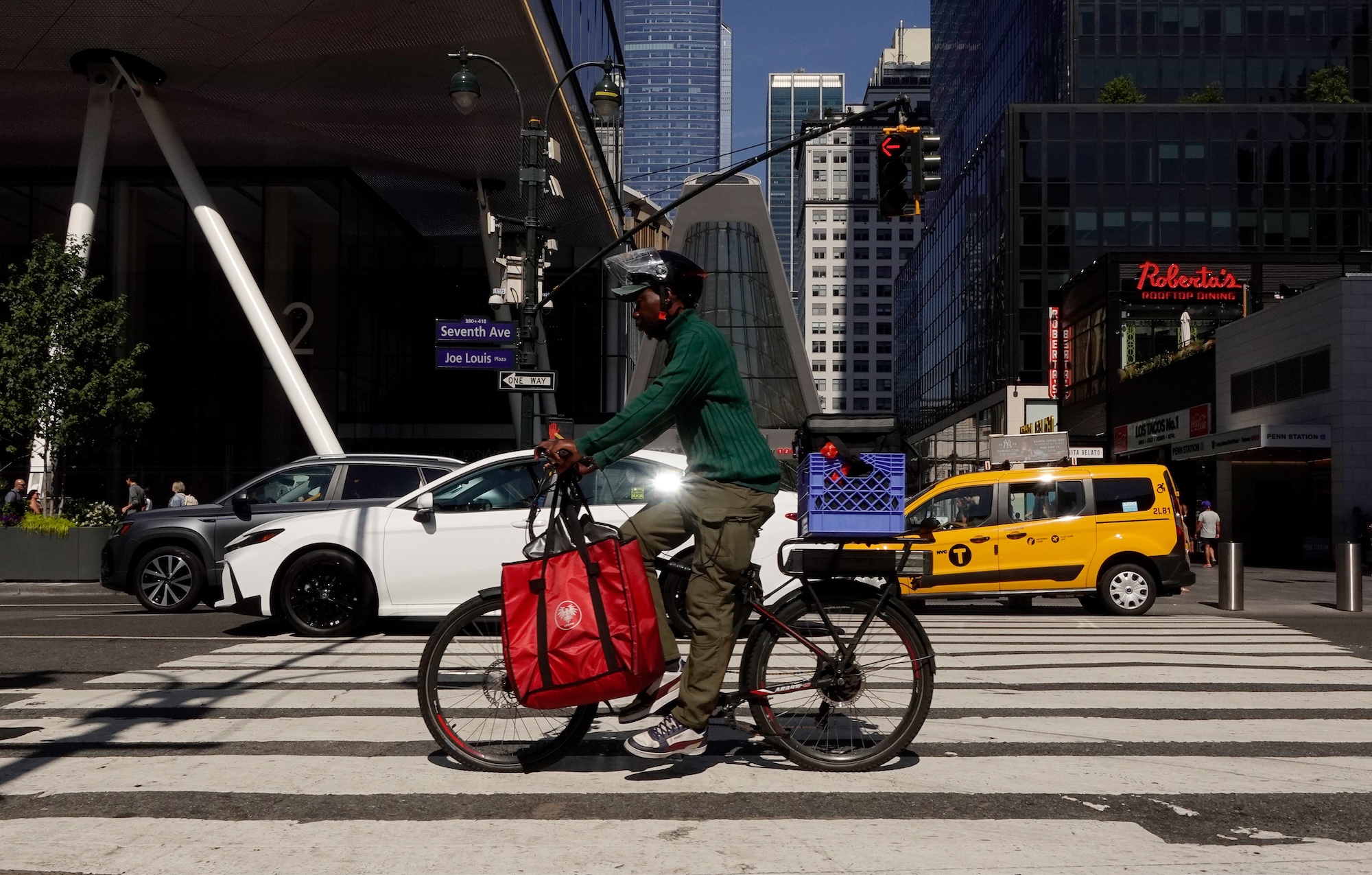
Of the roughly 70,000 delivery workers across New York City, many hail from Latin America, with a growing number from sub-Saharan Africa and South Asia, all regions facing the brunt of climate change.
Gary Hershorn / Getty Images
Yos is one of tens of thousands of app-based delivery workers in New York City, many of whom say that, regardless of the extreme weather conditions outside, they have no choice but to work.
“Everything that happens with the weather affects us in two ways,” said Yos in Spanish. “First, it puts our health and safety at risk. And second, it puts our livelihoods on the line.”
Most delivery workers in New York City ride two wheels — e-bikes or e-scooters — instead of cars, allowing them to mostly avoid traffic jams and cut down on delivery times. But working outside takes a physical toll on the body. [Exposure to extreme heat](https://grist.org/article/how-climate-change-affects-your-body-systems-health/), for example, can lead to dehydration, dizziness, nausea, heat stroke, and heart failure; heavy rainfall can lower visibility for both car drivers and cyclists, creating dangerous conditions on the road. The delivery apps don’t take any of this into consideration, said Yos.
“They don’t care, and they don’t give us extra time to pick up and drop off orders,” said Yos. “When it’s bad outside, we can’t hurry as well, and that in turn lowers our ratings.”
Resources for deliveristas
--------------------------
Do you work for a delivery app service in New York City? Read these guides by Documented that offer best practices for biking in dangerous conditions — from navigating icy roads to reckless drivers — and outline your legal rights and protections regardless of your immigration status.
[Know Your Rights as an NYC Deliverista](https://documentedny.com/2026/10/30/nyc-deliverista-delivery-driver-rights/)
[How NYC Delivery Workers Can Stay Safe During Rain and Snow](https://documentedny.com/2026/11/11/biking-rain-snow-nyc-delivery/)
[Injured By a Car During a Bike Delivery? What NYC Immigrants Need to Know About Getting Help](https://documentedny.com/2026/11/10/guide-nyc-bike-delivery-accident/)
1 of 1
Of the roughly [70,000 delivery workers](https://www.nyc.gov/mayors-office/news/2026/07/mayor-mamdani-delivers-more-than--100-million-for-delivery-worke) across the five boroughs, many hail from [Latin America](https://www.gchumanrights.org/preparedness/climate-crisis-in-latin-america-the-high-cost-of-government-inaction/), with a growing number being migrants from [sub-Saharan Africa](https://news.un.org/en/story/2025/05/1163126) and [South Asia](https://www.worldbank.org/en/brief/2022/02/10/integrating-climate-and-development-in-south-asia-region), all regions of the world facing the brunt of climate change. Many factors contributed to Yos’ decision to move from rural Guatemala to New York City, but part of it was that his family could no longer reliably depend on farming as a source of income due to [unpredictable rainfall](https://www.tandfonline.com/doi/full/10.1080/17565529.2013.857589). In recent years, Guatemala has suffered from [both droughts and flooding](https://www.tandfonline.com/doi/full/10.1080/17565529.2013.857589#d1e377) events, which have suppressed [crop yields](https://cipr.du.edu/cipr/content/rainfall-drought-and-emigration-guatemala-2015-2018); researchers have linked this volatility to [climate change](https://www.reuters.com/article/us-guatemala-climatechange-poor-idUSKCN1SA024/) in addition to [El Niño weather patterns](https://www.theguardian.com/global-development/2019/jul/29/guatemala-climate-crisis-migration-drought-famine).
Now in New York City, Yos struggles with [different extreme weather impacts](https://dec.ny.gov/environmental-protection/climate-change/effects-impacts). But as members of the so-called gig economy, Yos and other delivery workers are considered self-employed freelancers and lack adequate health and safety protections on the job.
Building on the recent successes of [including gig workers in the broader labor movement](https://www.wsj.com/us-news/americas-gig-workers-turn-to-an-old-school-union-6003e38d), Los Deliveristas Unidos, a labor union representing delivery workers, is on a mission to make city officials aware of delivery workers’ needs on the road. As this is happening, the impacts of climate change are also making their work increasingly dangerous.
“During heat waves, snowstorms, floods, and wildfire smoke events, they continue delivering essential goods — including water, medication, and groceries — to help people stay safe,” said Ligia Guallpa, executive director of the Worker’s Justice Project, which helps run Los Deliveristas Unidos. “In many ways, delivery workers serve as essential responders during emergencies,” she added.
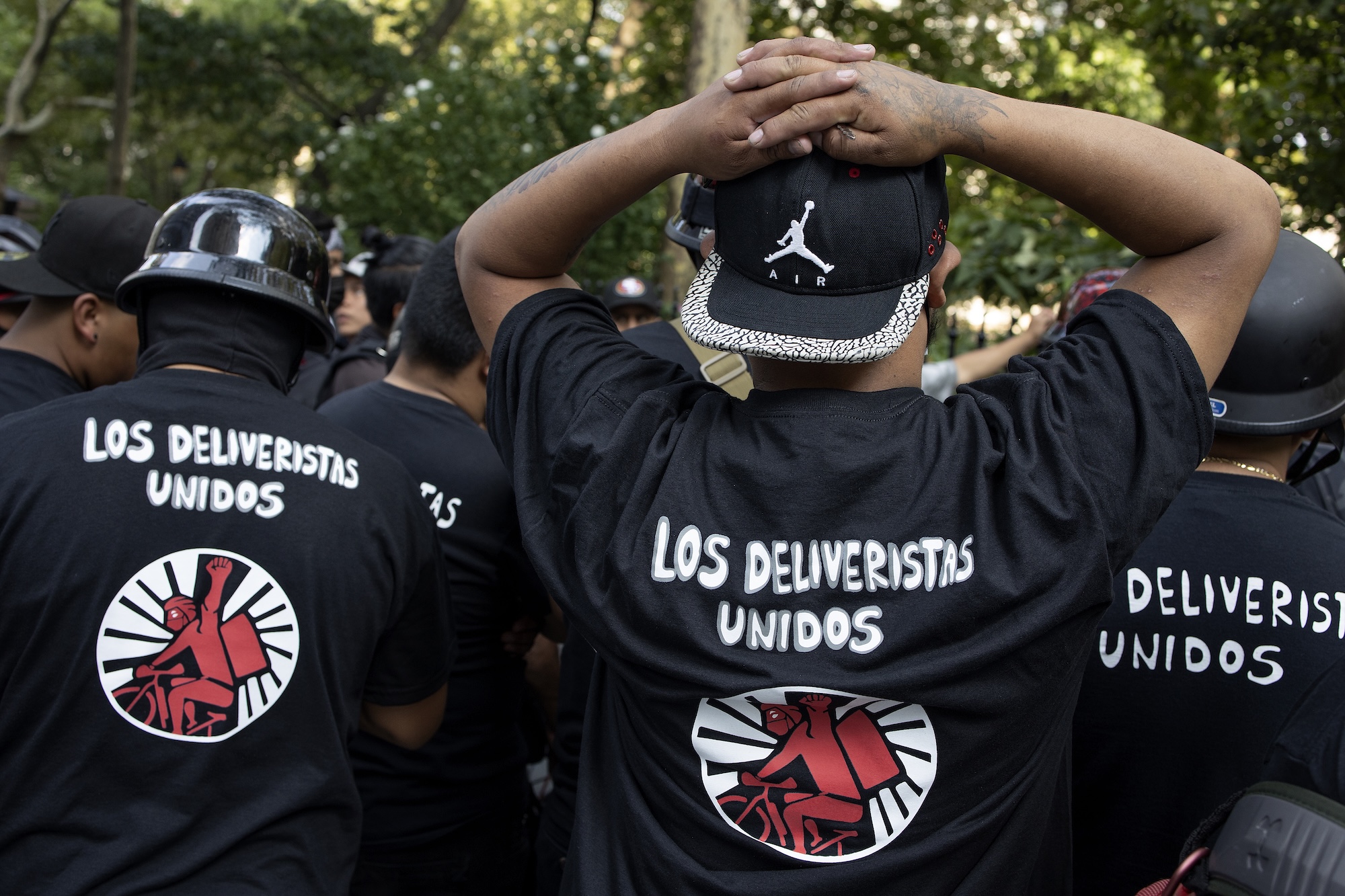
Food delivery workers at a 2021 union labor rally to demand better pay and working conditions.
Andrew Lichtenstein / Corbis via Getty Images
It’s one thing to acknowledge the critical role delivery workers play in the convenience economy of major cities like New York. It’s quite another to see delivery workers as experts with firsthand knowledge of how extreme weather collides with New York City’s infrastructure. Back home in Chimaltenango, Guatemala, Yos worked from a young age growing produce with his family to make ends meet. Now, at the other extreme of the food supply chain, he’s seen how extreme weather throws another wrench into how we eat today. The challenges Yos and his cohort face, like dangerous heat during the summer, flash flooding, and slippery roads with poor visibility during storms, will ultimately impact most New Yorkers, too.
---
Before the proliferation of app-based delivery companies in the mid-2010s, most delivery workers in New York City were employed directly by restaurants. Customers would place their food orders by phone, and the restaurant would dispatch a delivery worker straight to their door, assuming it was within a specific delivery range. But during the pandemic, delivery apps like DoorDash and Uber Eats exploded in popularity, with [spending via food delivery apps at quick-service restaurants tripling](https://www.ers.usda.gov/amber-waves/2024/january/pandemic-related-increase-in-consumer-restaurant-spending-using-mobile-apps-continued-through-2022) from about $400 million in December 2019 to $1.4 billion by 2022. Third-party delivery spending nearly quadrupled at full-service restaurants over that period, from about $100 million to about $400 million.
As New Yorkers endured the lockdowns, they grew reliant on food and grocery deliveries. Working the streets while most people hunkered down inside, delivery workers Gustavo Ajche and William Medin began to see how essential they were, and began to feel unappreciated by the delivery apps that provided no healthcare or workers’ compensation. That’s when they decided to organize.
In their early days, members of Los Deliveristas Unidos [focused on protecting themselves from robbery rings](https://www.curbed.com/2020/12/los-deliveristas-unidos-essential-workers-nyc-delivery.html) targeting their e-bikes, which delivery workers often call their “tools” and [cost around $2,000](https://www.rei.com/learn/expert-advice/cost-electric-bikes.html). Soon, the labor union’s work grew deeper in scope, focusing on a different kind of theft: the companies allegedly [stealing their wages](https://documentedny.com/2024/11/13/doordash-immigrant-delivery-workers-stolen-wages/).
In 2018, the mobile delivery app industry was [valued at $25.7 billion](https://www.statista.com/statistics/1091458/quick-service-restaurant-delivery-market-size-us/). Today, the market is worth [$428.2 billion](https://www.grandviewresearch.com/industry-analysis/online-food-delivery-services-market). With the expansion of the industry came a radical transformation in the city’s streetscape and labor force, which now includes some [20,000 more](https://www.nytimes.com/2020/11/30/nyregion/bike-delivery-workers-covid-pandemic.html) workers than before the pandemic. As app-based delivery companies disrupted the industry, seeing a s[urge in revenue](https://www.routific.com/10-stats-that-show-how-covid-19-impacted-food-delivery-services), the immigrant workers who made up the backbone of the industry [felt left behind](https://documentedny.com/2020/12/28/delivery-workers-are-struggling-to-survive-the-pandemic/).
All the while, Los Deliveristas grew into a formidable political force of nearly 15,000 active members, with reach in both City Hall and the state capital. In 2021, delivery workers won a historic, first-in-the-nation [minimum wage law](https://legistar.council.nyc.gov/LegislationDetail.aspx?ID=4927204&GUID=FCEA3CE8-8F00-4C8C-9AF1-588EA076E797&Options=ID%7CText%7C&Search=delivery) for app-based delivery workers. Before the law, delivery workers were paid well below the federal minimum wage rate of $5.39 per hour before tips. Now, workers often make at least [$19.56 per hour before tips](https://documentedny.com/2024/04/16/nyc-minimum-wage-app-workers-uber/).
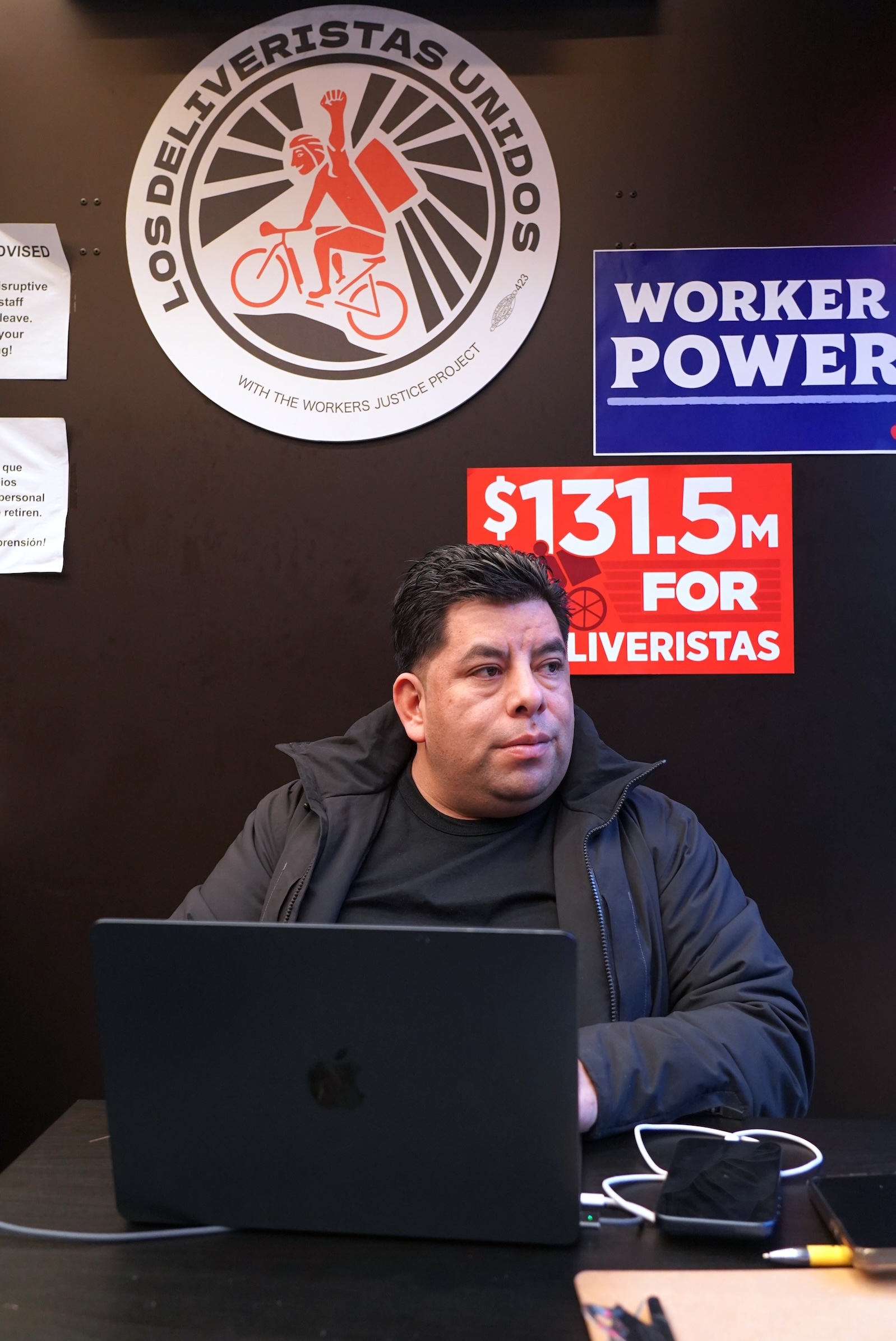
Despite the mixed results of their organizing, Gustavo Ajche and Los Deliveristas Unidos want the city to include the delivery workforce in its climate adaptation plans. Frida Garza / Grist
In 2021, Los Deliveristas also won the right to use [restaurant bathrooms and to tip](https://www.thecityreporter.nyc/2021/09/23/new-york-city-landmark-food-delivery-worker-law/) [transparency](http://transparency.in/). In 2024, Mayor Eric Adams, who delivery workers once considered an ally, turned on them by [proposing a law](https://www.nyc.gov/office-of-the-mayor/news/067-24/mayor-adams-lays-out-future-focused-vision-working-class-new-yorkers-third-state-the-city#/0) that would require them to be licensed by the city. Advocates like Worker’s Justice Project [feared it would open the door to greater criminalization](https://documentedny.com/2024/01/26/delivery-workers-department-sustainable-delivery/), and the union was able to push back. It was also able to win a [slew of new labor protections](https://documentedny.com/2026/01/29/five-new-delivery-worker-protections-take-effect-this-week/) that took effect this year.
Still, delivery work has been classified as one of the [most dangerous jobs in the city](https://cunyurbanfoodpolicy.org/resources/report/driven-by-algorithms/), in part because workers report they cannot take breaks or slow down during bad weather conditions. The risks to their personal safety have grown as [climate change drives](https://www.nyc.gov/assets/dep/downloads/pdf/environment/education/climate-change-introduction-presentation.pdf) [heavier rainfall and warmer days](https://www.climatecentral.org/climate-local/41528) in the region. This summer was the [wettest summer in five years](https://ny1.com/nyc/all-boroughs/news/2026/09/01/new-york-city-wet-summer-2026), with a whopping 16.92 inches of precipitation recorded from June to August, according to the National Weather Service. Just under half — or about 40 percent — of the days in that period were wet. When it does pour, the city’s pain points become abundantly clear. Subways leak, storm drains get clogged with trash, and streets flood.
During the early days of the pandemic, Ajche said he and his fellow bikers had to search high and low for a place to take a break from the weather. He got the idea to convert unused newsstands throughout the city into rest areas.
Later in 2020, the idea became closer to a reality. On October 13, 2020, [Senator Chuck Schumer biked](https://newlaborforum.cuny.edu/2023/05/10/los-deliveristas-unidos-and-the-ideals-of-worker-justice/) through the empty streets of Manhattan alongside Ajche, who pitched him the idea. Schumer and Adams [threw their weight behind](https://www.nyc.gov/mayors-office/news/2022/10/mayor-adams-majority-leader-schumer-first-in-nation-street-deliveristas-hubs-serve) the idea two years later, in 2022, announcing $1 million in city and federal funding for the project.
“Part of our goal is how the city of New York can bring in deliveristas as part of the conversation on city planning or emergency response,” said Guallpa.
By the time Adams’ term was up in 2025, the newsstand-to-delivery-worker-hub conversion had yet to begin. Upon taking office this year, Mayor Zohran Mamdani [made it a goal](https://www.nytimes.com/2026/04/07/nyregion/how-to-build-a-rest-stop-for-delivery-workers-in-a-hurry.html) to open the first deliverista hub within his first 100 days. Design and engineering teams got to work, condensing a process that would normally take two years into a couple of months. In April, the first delivery-worker hub officially [opened](https://documentedny.com/2026/04/07/delivery-worker-hub-nyc/), with much fanfare. But the results of the shortened construction timeline were obvious: The hub [didn’t have electricity](https://documentedny.com/2026/04/29/city-hall-delivery-hub-coned-power-delay/) on opening day. Plans for a second hub in the Upper West Side also [stalled after fierce community pushback](https://www.westsiderag.com/2023/12/17/block-associations-band-together-to-oppose-deliverista-hub-at-west-71st-street).
Due to workers’ organizing efforts, the apps have taken steps to make delivery work safer. Although Uber Eats did not wish to comment for this story, they did point to their partnership with the [Governors Highway Safety Association](https://www.ghsa.org/) in developing a [bike safety checklist](https://www.uber.com/blog/ghsa-bicycle-delivery-safety-tips/#%3A%7E%3Atext=Keep+your+hands+on+your%2CRide+predictably.) for delivery workers, which provides tips on key safety issues such as helmet protection, following traffic laws, and staying visible. Uber Eats also now provides workers with safety gear like helmets and yellow safety vests. Uber is [required by city law](https://www.nyc.gov/html/dot/downloads/pdf/delivery-safety-letter-to-apps.pdf) to provide safety equipment and educational materials to delivery workers.
GrubHub also declined to comment for this story, instead [referring to its website](https://driver.grubhub.com/driver-safety/) for information regarding its worker safety policies.
Samantha Ramirez, Policy Communications Manager at DoorDash, says that the company has taken steps to protect its delivery workers from extreme weather by developing a Severe Weather Protocol. DoorDash closely monitors weather changes and issues proactive warnings and safety guidance to workers, merchants, and customers. In extreme weather conditions, the company will even temporarily suspend all operations if needed.
“We also send reminders to Dashers on how to stay safe in cases where it’s hotter or colder outside than normal, or if there’s exceptionally bad air quality,” Ramirez said in a statement. “We encourage anyone experiencing severe weather conditions to follow guidance from local authorities, take the right precautions, and prioritize their safety.”
---
Despite the mixed results, Guallpa and Los Deliveristas Unidos want the city to include the delivery workforce in its climate adaptation plans.
“We need policies that reflect the realities delivery workers face, including safe working conditions, hazard pay, and meaningful protections that allow them to prioritize their health and safety without risking their livelihoods,” she said. “Delivery workers must have a seat at the table as our cities prepare for and respond to the climate crisis.”
In response to a request for comment, Deputy Press Secretary for the Mayor’s Office Jeremy Edwards said, “Mayor Mamdani knows that delivery workers keep this city running,” and that City Hall knows “that these workers have no choice but to brave the elements.” He added that the administration is committed to protecting all New Yorkers — including delivery workers — from extreme weather, and would keep working with Worker’s Justice Project to do so.
One of the ways that Guallpa hopes the city can improve conditions for delivery workers is by holding the apps accountable for worker safety. Earlier this month, New York City Council Member Harvey Epstein [introduced a bill](https://legistar.council.nyc.gov/LegislationDetail.aspx?ID=8317567&GUID=0F1B1613-A084-4269-AE8C-BAC559EE6491&Options=Advanced&Search=) that would force the delivery apps to provide workers with bathroom access, rest stops, e-bike charging stations, and bike storage facilities.
“I support delivery workers’ right to make deliveries in our neighborhood, and delivery app platforms must be held accountable for the hazardous working conditions that impact both deliveristas and our neighborhoods,” said Epstein in a statement.
Read Next
[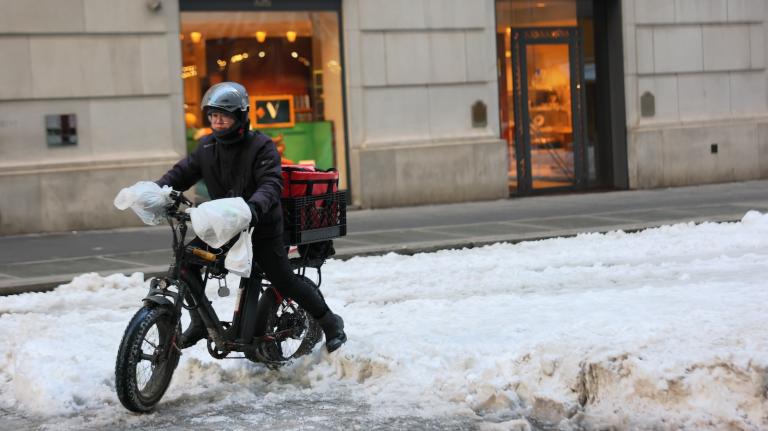](https://grist.org/labor/new-york-city-unveils-its-first-rest-stop-for-delivery-workers/)
[New York City unveils its first rest stop for delivery workers](https://grist.org/labor/new-york-city-unveils-its-first-rest-stop-for-delivery-workers/)
[Frida Garza](https://grist.org/author/frida-garza/)
Both in their home countries and in New York City, climate change has quietly shaped the lives of workers like José Yos. But whether or not they should be classified as climate migrants is a complicated question. According to Erica Bower, who leads research on climate displacement at the international NGO Human Rights Watch, in order to be considered a climate migrant, individuals must have relocated as a direct response to environmental factors like a natural disaster — and those factors must have been made more likely or more intense because of climate change. But it’s often difficult to prove climate change is a driver of a particular extreme weather event — and it’s also tricky to pinpoint any one individual’s reasons for leaving home. As a result, Bower argues that the terms “climate migrant” and “climate refugee” should be used sparingly. Workers like Yos are more accurately described as labor migrants, Bower and others say, because they left their homes in search of better economic opportunities.
Migrants themselves may not even bring up climate volatility or natural disasters when asked about their reasons for leaving. There are likely many reasons for this: Researchers have hypothesized that environmental factors may reasonably be less front-of-mind as an immediate threat for someone seeking to escape poverty. But in an age of global warming, even migrants who are primarily searching for better economic conditions can have all sorts of stories regarding how a shifting climate uprooted their quality of life back home. Whether or not they share those accounts when asked about their reasons for moving often depends on how the question is phrased, said Lawrence Huang, a researcher focused on climate change and migration at the Migration Policy Institute.
For example, when the Mixed Migration Centre, a research hub under the Danish Refugee Council, asked West and Central African migrants to list the reasons why they moved away, fewer than 5 percent across regions and genders “spontaneously” mentioned environmental factors. But when prompted to think specifically about the role that natural disasters and other environmental challenges played in their journeys, respondents’ stories changed.
Roughly 30 to 40 percent then said environmental risks were related to the economic drivers of their migration. On average, another 14 percent said environmental factors directly impacted their living conditions at home, and 12 percent said environmental factors made them see how making a living there would be difficult in the long run.
Rather than standing alone as a motivation for migration, extreme weather conditions act as a “stress multiplier,” authors of the [Mixed Migration Centre briefing paper](https://mixedmigration.org/themes/migration-drivers-decision-making/) wrote.
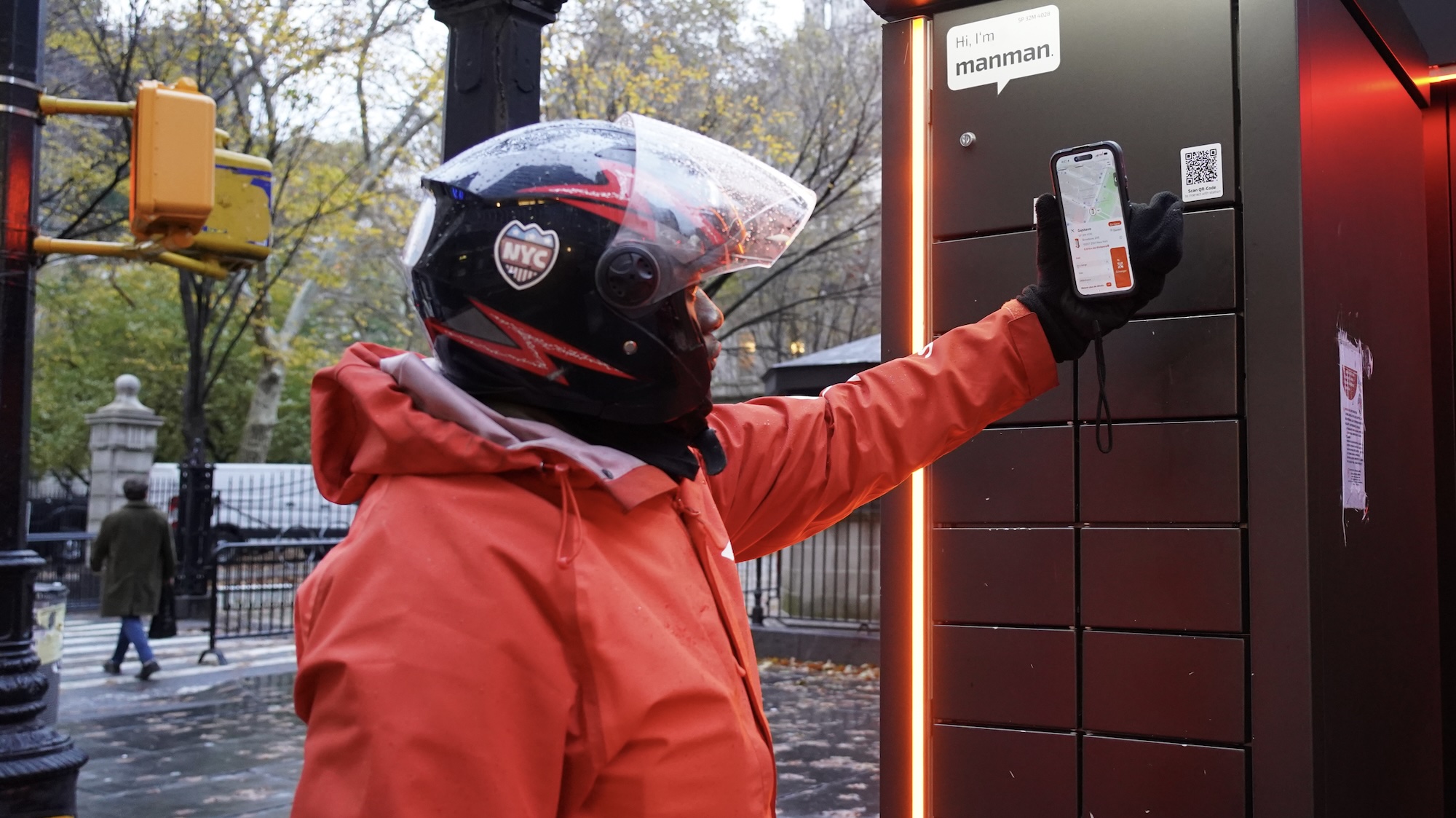
The question of whether delivery workers count as climate migrants potentially carries with it real-life ramifications — access to designated city services and resources. Frida Garza / Grist
Speaking to delivery workers in New York City sheds light on how rising temperatures and other climate impacts add to the pressure to leave home.
Growing up in Nepal, Hari Sharan Tripathi worked on his family farm in Pokhara, tending orange trees. The groves had long been a steady source of income, but that changed when they started to yield less and less fruit.
“Those orange trees used to be grown by my grandfather and great-grandfather,” Tripathi said in Nepali. “We used to make money from selling those oranges, and our neighbors as well.”
Rising global temperatures are partly to blame.
As a child, Tripathi would stare at the snow-capped peak of Mount Machhapuchhre reflected in the clear waters of Phewa Lake. But before leaving his hometown, he looked back at the reflection once more.
“The snow started receding, and you could hardly see snow on the bases of mountains,” Tripathi, now 35, said. “Then there used to be some days where you couldn’t see snow in the mountains at all.”
Read Next
[](https://grist.org/culture/this-sicilian-community-has-endured-for-centuries-can-it-survive-a-changing-climate/)
[This Sicilian community has endured for centuries. Can it survive a changing climate?](https://grist.org/culture/this-sicilian-community-has-endured-for-centuries-can-it-survive-a-changing-climate/)
[Stefania D’Ignoti](https://grist.org/author/stefania-dignoti/)
Nepal is ranked fourth among the [most vulnerable countries](https://www.undp.org/nepal/our-focus/resilience) to the effects of global warming. In August, when thousands died and went missing because of [catastrophic flash floods](https://news.un.org/en/story/2026/10/1168651), scientists pointed to the glacier [melt on mountains like Mount Machhapuchhre](https://www.insidehimalayas.com/melting-mt-macchapucchre-are-we-ignoring-the-signs/) as a [contributing factor](https://www.npr.org/2026/08/28/nx-s1-5945799/nepal-floods-climate-change-himalayas). And climate impacts like unpredictable rainfall, which contribute to declines in agricultural productivity, have helped [fuel an outward migration](https://cansouthasia.net/migration-in-nepal-through-the-lens-of-climate-change/) of people like Tripathi seeking better economic opportunities.
In the Big Apple, Tripathi, who is a member of another delivery worker [advocacy organization](https://documentedny.com/2024/04/16/nyc-minimum-wage-app-workers-uber/) called [Justice for App Workers](https://justiceforappworkers.org/), continues to struggle with the effects of global climate change. With the city’s weather becoming more volatile due to climate change, as a delivery worker for Uber Eats, he routinely battles all manner of extreme weather, including heavy rainfall and flash flooding [made worse by climate change](https://www.theguardian.com/us-news/2025/jul/16/new-york-floods-storm-climate-change). He’s also struggled to adapt to New York City’s cold winters, and particularly had issues on the road with snow and ice.
“I have fallen off my bike multiple times during snowy weather,” he said. “I didn’t know a bike could skid off the road because of black ice. I didn’t know anything about black ice.”
The city makes an effort to reach all New Yorkers with critical communication about extreme cold weather, sending alerts about snow, ice, and changing weather conditions in 14 languages, including English, Arabic, Chinese, Spanish, and Bengali. And this month, City Hall announced it would spend $25 million on upgrading its emergency weather protocol for freezing overnight temperatures known as Code Blue. The city’s Department of Transportation has also spent $2 million on new small snow-clearing equipment to help keep bike lanes clear of snow and ice.
---
The question of whether workers like Tripathi and Yos count as climate migrants carries with it real-life ramifications. For example, in recent years, New York City Council members have [proposed creating](https://legistar.council.nyc.gov/LegislationDetail.aspx?ID=5570532&GUID=A895E8C8-14DE-4C53-851C-B85751BEAEA6&Options=&Search=) [a climate migration services coordinator](https://intro.nyc/1192-2025+), or someone who helps the city both identify climate-displaced newcomers and connect them with social services. These bills haven’t gone anywhere, but they’re an example of how the city could do outreach to vulnerable populations on a warming planet.
Meanwhile, for the migrant delivery workers already here, the rain has become a particular problem.
Being a coastal city, New York is exposed to [many types of flooding](https://climateassessment.nyc/assessment/overview/) — but climate change has [increased the risk of pluvial flooding](https://www.nyc.gov/content/climate/pages/extreme-rainfall), where rainfall exceeds what an area’s sewer or drainage system can handle. That can happen due to cloudbursts — large downpours of rain that start and stop abruptly, in a relatively short amount of time — and can result in flash flooding at the street level.
Earlier this year, City Hall and the New York City Department of Environmental Protection invested $108 million in [upgrading the city’s sewer system](https://www.nyc.gov/mayors-office/news/2026/03/mayor-mamdani-invests--108-million-to-improve-sewer-performance-) — specifically catch basins, or the street-level storm drains that lead to the sewers. Making sure that rainwater can flow freely through the streets and into the sewer network — and not start to pool around a clogged catch basin — would greatly improve street safety, said Yos.
But heavy rainfall still presents other risks to cyclists on the road, such as low visibility.
Saliou Ndiaye, a 26-year-old Senegalese delivery worker, has also had to contend with the weather. In 2022, while making a delivery, Ndiaye was hit by a car during a rainstorm because the driver was unable to see him, he said.
“I tried to avoid it. I did everything I could, but he hit me,” he said. “I flew in the air and was rolling.”
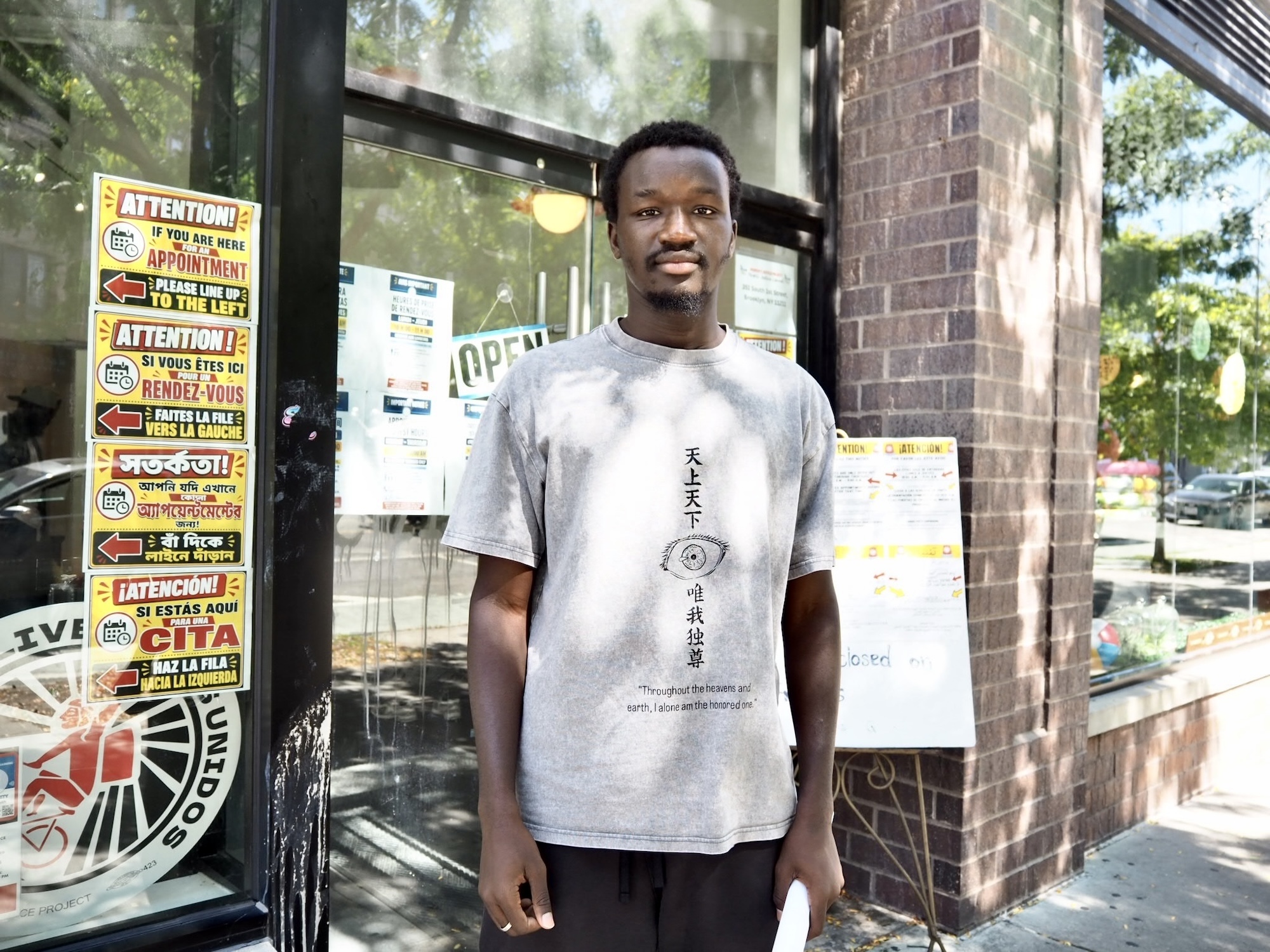
For Saliou Ndiaye, the weather — especially rain — shaped his life in Senegal, and continues to now in New York City.
Amir Khafagy / Documented
He broke his leg and was unable to work for nearly a year until he recovered. “I was scared, you know,” he said. “When you see your leg broken, it’s scary. You freak out.”
Ndiaye said the weather also shaped his life in Thiès, Senegal’s third-largest city, his hometown. Senegal’s rainy season typically [lasts between May and September](https://www.wacaprogram.org/article/floods-senegal-are-retention-basins-part-solution), but with climate change affecting the seasonal pattern, storms are increasingly occurring during the dry season. Flooding in particular [has gotten worse](https://reliefweb.int/report/senegal/unicef-senegal-humanitarian-situation-report-no-1-floods-17-august-17-september-2025). The country’s most severe flood ever occurred in 2024, leaving thousands homeless.
“It’s worse because every time it rains, the whole day is raining, and there will be floods,” said Ndiaye. “You know, people’s homes are filled with water.”
Mansour Thioye, a 37-year-old Senegalese delivery worker, said in his hometown of Kaolack, [flooding has become a routine part of life](https://floodlist.com/africa/senegal-floods-dakar-kaolack-september-2019).
“When it’s raining, it’s very bad to live there,” said Thioye, who returns home regularly. He noted that sometimes families will take shelter in schools for months because of flood damage to their homes. “They use the classrooms to live because they don’t have anywhere to go.”
Thioye said that in New York, where he has now lived for 15 years and raised his family of four children, rain has also been a force to contend with as a delivery worker.
“When it’s raining, it’s so bad,” he said. “The drivers here, they don’t pay attention to when their car door is open, and we can crash into the door. That’s happened to me two times.”
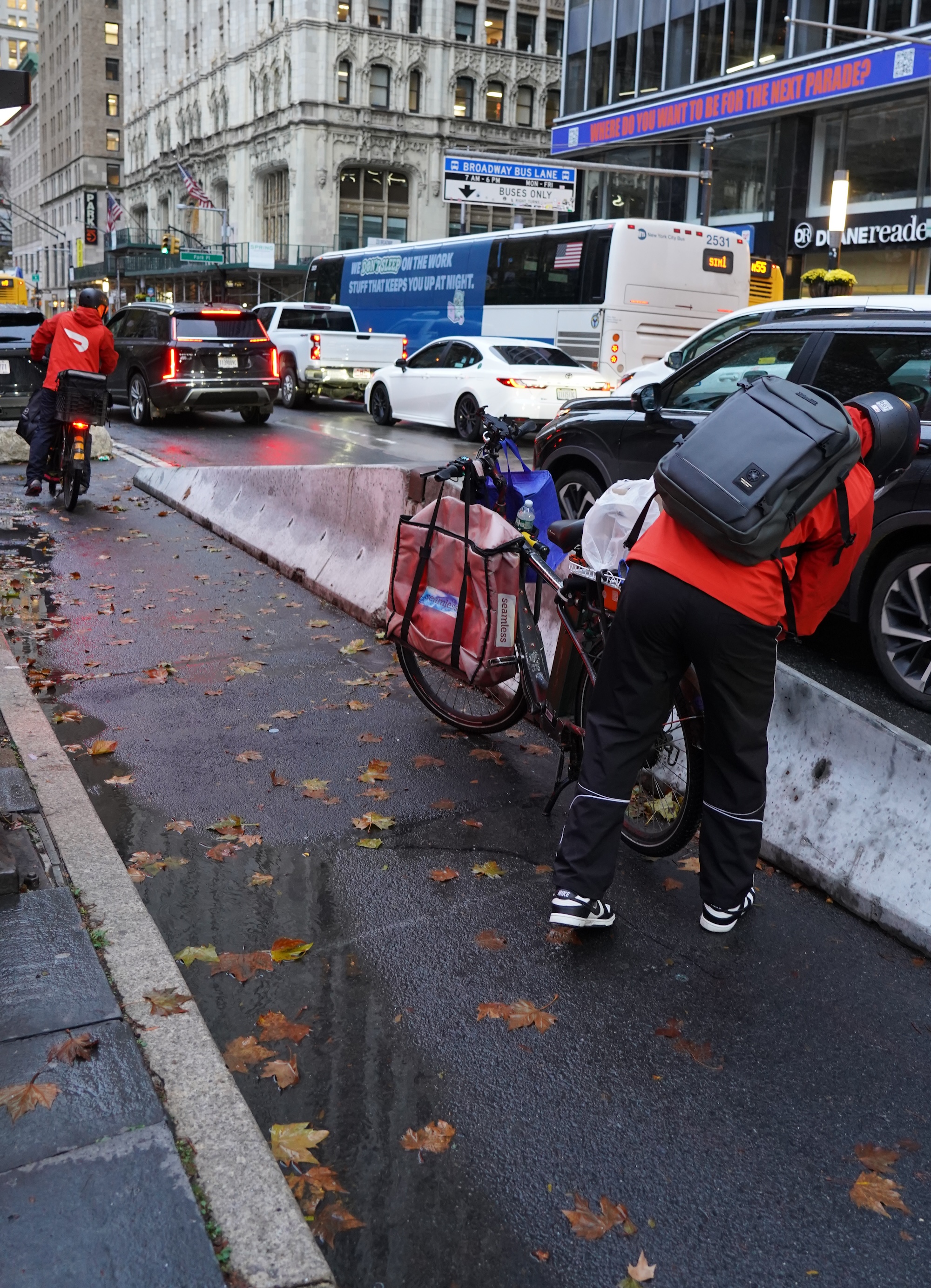
Making sure that rainwater can flow freely into the sewer network would greatly improve street safety for delivery workers. Frida Garza / Grist
How cities and states in the U.S. adapt to climate change — and prepare for any influx of climate migrants — is playing out in real time. Last year, Illinois passed a first-of-its-kind climate migration law, which was meant to kick off the creation of a task force that would study how incoming climate migrants might test the state’s infrastructure. But a year later, [only one seat on the task force had been filled](https://grist.org/migration/illinois-passed-the-nations-first-climate-migration-law-the-effort-has-languished-since/). (A second person was appointed to the task force after Grist reached out for comment earlier this year.)
It’s obvious that there is much that local and state governments around the country can do to anticipate what a warmer future might bring, even in terms of population changes. In New York City and elsewhere, elected officials could learn from listening directly to migrants themselves about what their needs are. Ask just about any delivery worker, and they’ll tell you the connection between the weather and their job is obvious: The worse the weather, the more people order food and groceries to their door.
This story was originally published by [Grist](https://grist.org/) with the headline [They migrated to New York for work. Now they’re fighting to climate-proof it.](https://grist.org/food-and-agriculture/they-migrated-to-new-york-for-work-now-theyre-fighting-to-climate-proof-it/) on Nov 18, 2026.
---
**From [Grist](https://grist.org/feed) via [This RSS Feed](https://grist.org/feed).**",
"community": "[email protected]",
"community_title": "Green & indigenous News",
"creator": "[email protected]",
"score": 9,
"comments": 0,
"published": "2026-11-18T10:36:23.261450Z",
"nsfw": false,
"upvotes": 9,
"downvotes": 0,
"newest_comment_time": "2026-11-18T10:36:23.261450Z",
"updated": null,
"thumbnail_url": "https://lemmy.world/pictrs/image/e371369e-6dc6-4136-a537-4023f7d0aa28.jpeg",
"image_width": 512,
"image_height": 327,
"alt_text": null,
"embed_title": "They migrated to New York for work. Now they’re fighting to climate-proof it.",
"embed_description": "The worse the weather gets, the more delivery riders work. Can they teach the city how to adapt against climate-fueled disasters?",
"embed_video_url": null,
"url_content_type": "text/html; charset=utf-8",
"language_id": 0,
"language": null,
"featured": false,
"locked": false,
"creator_display_name": null,
"creator_avatar": "https://news.abolish.capital/pictrs/image/dd8a8e16-ab8b-4e9a-92fd-cde6028b15b4.png",
"creator_url": "https://news.abolish.capital/u/rss",
"creator_bot": true,
"community_url": "https://news.abolish.capital/c/ecosocial",
"community_icon": "https://news.abolish.capital/pictrs/image/8d15e220-cea2-4879-b116-d3ba4e318257.png",
"scraped_at": "2026-11-19T11:07:36.297774+00:00"
},
{
"id": 54232850,
"name": "Blue Valley School District to ban electric bikes and scooters starting Jan. 1",
"url": "https://fox4kc.com/news/blue-valley-bans-electric-bikes-and-scooters-starting-jan-1/",
"ap_id": "https://lemmy.sdf.org/post/61633364",
"body": null,
"community": "[email protected]",
"community_title": "micromobility - Bikes, scooters, boards: Whatever floats your goat, this is micromobility",
"creator": "[email protected]",
"score": 8,
"comments": 0,
"published": "2026-11-10T11:07:52.831691Z",
"nsfw": false,
"upvotes": 8,
"downvotes": 0,
"newest_comment_time": "2026-11-10T11:07:52.831691Z",
"updated": null,
"thumbnail_url": null,
"image_width": null,
"image_height": null,
"alt_text": null,
"embed_title": "Access to this page has been denied",
"embed_description": "px-captcha",
"embed_video_url": null,
"url_content_type": "text/html",
"language_id": 37,
"language": "en",
"featured": false,
"locked": false,
"creator_display_name": "52fighters",
"creator_avatar": "https://lemmy.sdf.org/pictrs/image/382afea9-c130-4246-b5e5-229806e3e2c2.png",
"creator_url": "https://lemmy.sdf.org/u/52fighters",
"creator_bot": false,
"community_url": "https://lemmy.world/c/micromobility",
"community_icon": null,
"scraped_at": "2026-11-19T11:07:36.297774+00:00"
},
{
"id": 54125559,
"name": "Made an easy method for converting cargo bikes over to solar!",
"url": "https://lemmy.world/pictrs/image/41efa519-fd06-48db-9038-2b21edd8caa5.jpeg",
"ap_id": "https://lemmy.world/post/54125559",
"body": "cross-posted from: https://lemmy.world/post/54123088
> Here's two of the guides I wrote. The image above is an lectric xpedition v1. With a 24qt milkcrate and a 50w solar panel above. Not seen is a foldable solar trailer that this thing can tow.
> [https://www.instructables.com/Ebike-to-Solar-Bike-Conversion-50w-Milkcrate-Metho/](https://www.instructables.com/Ebike-to-Solar-Bike-Conversion-50w-Milkcrate-Metho/)
>
> [https://www.instructables.com/Solar-Bike-Trailer-for-Charging-Electric-Bikes/](https://www.instructables.com/Solar-Bike-Trailer-for-Charging-Electric-Bikes/)
>
> ",
"community": "[email protected]",
"community_title": "micromobility - Bikes, scooters, boards: Whatever floats your goat, this is micromobility",
"creator": "[email protected]",
"score": 53,
"comments": 5,
"published": "2026-11-08T01:39:28.114363Z",
"nsfw": false,
"upvotes": 53,
"downvotes": 0,
"newest_comment_time": "2026-11-12T14:14:30.270535Z",
"updated": null,
"thumbnail_url": "https://lemmy.world/pictrs/image/57fcecf0-fbde-4b2e-a563-253b38fa49ec.jpeg",
"image_width": 512,
"image_height": 384,
"alt_text": null,
"embed_title": null,
"embed_description": null,
"embed_video_url": null,
"url_content_type": "image/jpeg",
"language_id": 37,
"language": "en",
"featured": true,
"locked": false,
"creator_display_name": null,
"creator_avatar": "https://lemmy.world/pictrs/image/6a7c236d-22cb-4497-8012-d8a7f4716da6.jpeg",
"creator_url": "https://lemmy.world/u/SolarpunkWorkshop",
"creator_bot": false,
"community_url": "https://lemmy.world/c/micromobility",
"community_icon": null,
"scraped_at": "2026-11-19T11:07:36.297774+00:00"
},
{
"id": 54124174,
"name": "Made some easy methods for converting cargo ebikes over to solar!",
"url": "https://lemmy.world/pictrs/image/41efa519-fd06-48db-9038-2b21edd8caa5.jpeg",
"ap_id": "https://lemmy.world/post/54124174",
"body": "cross-posted from: https://lemmy.world/post/54123088
> Made an easy method for converting cargo bikes over to solar!
>
> Here's two of the guides I wrote. The image above is an lectric xpedition v1. With a 24qt milkcrate and a 50w solar panel above. Not seen is a foldable solar trailer that this thing can tow.
> [https://www.instructables.com/Ebike-to-Solar-Bike-Conversion-50w-Milkcrate-Metho/](https://www.instructables.com/Ebike-to-Solar-Bike-Conversion-50w-Milkcrate-Metho/)
>
> [https://www.instructables.com/Solar-Bike-Trailer-for-Charging-Electric-Bikes/](https://www.instructables.com/Solar-Bike-Trailer-for-Charging-Electric-Bikes/)",
"community": "[email protected]",
"community_title": "Electric Bikes",
"creator": "[email protected]",
"score": 13,
"comments": 1,
"published": "2026-11-08T00:59:50.984816Z",
"nsfw": false,
"upvotes": 14,
"downvotes": 1,
"newest_comment_time": "2026-11-17T10:45:34.841500Z",
"updated": null,
"thumbnail_url": "https://lemmy.world/pictrs/image/e676471d-919b-4ee7-8286-1521b4df5ea8.jpeg",
"image_width": 512,
"image_height": 384,
"alt_text": null,
"embed_title": null,
"embed_description": null,
"embed_video_url": null,
"url_content_type": "image/jpeg",
"language_id": 37,
"language": "en",
"featured": false,
"locked": false,
"creator_display_name": null,
"creator_avatar": "https://lemmy.world/pictrs/image/6a7c236d-22cb-4497-8012-d8a7f4716da6.jpeg",
"creator_url": "https://lemmy.world/u/SolarpunkWorkshop",
"creator_bot": false,
"community_url": "https://lemmy.world/c/electricbikes",
"community_icon": "https://lemmy.world/pictrs/image/c249789d-077c-4a8c-b352-d2dc193fcdc1.jpeg",
"scraped_at": "2026-11-19T11:07:36.297774+00:00"
},
{
"id": 54123088,
"name": "Made an easy method for converting cargo bikes over to solar!",
"url": "https://lemmy.world/pictrs/image/41efa519-fd06-48db-9038-2b21edd8caa5.jpeg",
"ap_id": "https://lemmy.world/post/54123088",
"body": "Here's two of the guides I wrote. The image above is an lectric xpedition v1. With a 24qt milkcrate and a 50w solar panel above. Not seen is a foldable solar trailer that this thing can tow.
[https://www.instructables.com/Ebike-to-Solar-Bike-Conversion-50w-Milkcrate-Metho/](https://www.instructables.com/Ebike-to-Solar-Bike-Conversion-50w-Milkcrate-Metho/)
[https://www.instructables.com/Solar-Bike-Trailer-for-Charging-Electric-Bikes/](https://www.instructables.com/Solar-Bike-Trailer-for-Charging-Electric-Bikes/)
",
"community": "[email protected]",
"community_title": "Cargo Bikes",
"creator": "[email protected]",
"score": 35,
"comments": 7,
"published": "2026-11-08T00:07:11.685172Z",
"nsfw": false,
"upvotes": 36,
"downvotes": 1,
"newest_comment_time": "2026-11-08T17:41:12.184962Z",
"updated": null,
"thumbnail_url": "https://lemmy.world/pictrs/image/30990c04-75ba-430e-9c54-31f4801f0380.jpeg",
"image_width": 512,
"image_height": 384,
"alt_text": null,
"embed_title": null,
"embed_description": null,
"embed_video_url": null,
"url_content_type": "image/jpeg",
"language_id": 0,
"language": null,
"featured": false,
"locked": false,
"creator_display_name": null,
"creator_avatar": "https://lemmy.world/pictrs/image/6a7c236d-22cb-4497-8012-d8a7f4716da6.jpeg",
"creator_url": "https://lemmy.world/u/SolarpunkWorkshop",
"creator_bot": false,
"community_url": "https://lemmy.world/c/cargobikes",
"community_icon": "https://lemmy.world/pictrs/image/1b45e0dd-a5e2-42cd-9d54-165257b3e3bb.jpeg",
"scraped_at": "2026-11-19T11:07:36.297774+00:00"
},
{
"id": 53453760,
"name": "Soaring oil prices underscore the need to help poor countries adopt renewables",
"url": "https://grist.org/international/oil-prices-developing-countries-energy-transition-iran-war/",
"ap_id": "https://news.abolish.capital/post/87818",
"body": "War-induced spikes in oil prices and the arrival of artificial intelligence are widening the economic gap between rich and poor countries, according to [the International Monetary Fund’s October report on the world economy](https://www.imf.org/-/media/files/publications/weo/2026/october/english/text.pdf). Poorer countries that import most of their fossil fuels have suffered the worst consequences of the United States’ and Israel’s war on Iran, while wealthier countries have better withstood war-related shocks thanks to AI-related economic growth and diversified energy systems, the report said.
Renewable and clean energy could help poorer countries strengthen their economies against future economic turbulence, but a well-planned energy transition requires resources these countries don’t have. Instead, families and companies in developing countries are pursuing their own ad hoc energy transitions with cheap electric motorbikes and rooftop solar panels. Demand for an energy transition in poor economies is here, experts say, but no one is providing the planning and money to make it orderly or equitable.
“Getting off oil is the only solution to this long-standing, but currently very acute, economic vulnerability,” said Rebecca Ray, an economist studying global sustainable development at Boston University. “The question is, who’s going to pay for it?”
Oil and gas prices, which have soared as wars in the Middle East and Ukraine have destroyed refineries and closed shipping routes, have made all kinds of products more expensive, including fertilizer and goods that must be shipped with fossil fuel-burning engines. Those high prices hit hardest in poor countries, where people and governments already [struggle to afford necessities](https://apnews.com/projects/days-disrupted-after-iran-war/).
High fossil fuel prices can also have unwelcome knock-on effects in poor countries, like making it harder for the governments to borrow money. Rising fuel prices slow down an economy, meaning governments take in less tax money. Investors then get skittish about lending to those governments because of their weakened incomes. Governments must then take on riskier loans with steeper interest rates to stay afloat, adding to already [high costs of borrowing](https://www.pbs.org/newshour/world/imf-chief-urges-wealthy-nations-to-rein-in-debt-to-ease-global-economic-pressure). That can lock them into financial trouble and make it harder for them to spend on their people.
“The world’s poorest countries are likely to see their productivity and growth momentum decelerate and the gap in their per capita incomes relative to those in advanced economies widen” through the early 2030s, the IMF report states. The report echoes repeated [warnings about the global impacts of the war in Iran](https://www.usnews.com/news/world/articles/2026-04-08/imf-world-bank-and-uns-world-food-program-say-war-is-increasing-food-insecurity) from international organizations since early in the year.
Still, residents of low-income countries are responding to the crisis by seeking opportunities for resilience. Even before fuel prices spiked from war in the Middle East, private citizens and companies in poor countries were investing in their own renewable energy. The war seems to have accelerated those trends or demonstrated their value.
For instance, electric mopeds and motorcycles now zip through crowded intersections in Vietnam, where their sales nearly [doubled after the outbreak of the war](https://www.motorcyclesdata.com/2026/08/19/vietnam-motorcycles/), now representing 28 percent of new two-wheel vehicles sold. In Pakistani cities, rooftop solar had effectively [doubled the country’s electricity capacity](https://ember-energy.org/latest-insights/the-solarisation-of-pakistans-energy-economy/) in two years leading up to the war. After the war began, [all those solar panels kept the country’s electricity prices fairly stable](https://www.sciencedirect.com/science/article/pii/S0301421526005963?dgcid=rss_sd_all&__cf_chl_tk=mJGh2Djr4GWued1tALeXd87bCKSuVRTvxf3GfhQB6kI-1792524543-1.0.1.1-Vrg6JZMgU7MntPpSlRg5viavWOJxarYSX9zWgqtXjJw), shielding the country from the same economic shocks it experienced following Russia’s invasion of Ukraine in 2022.
An energy transition is happening, but it’s not a systematic change. And it’s not equally distributed among the people of poor countries. Installing so much unplanned rooftop solar takes wealthier households off power grids, leaving poorer households to pay for the grids’ improvements. EV growth can strain grids without the appropriate planning and infrastructure improvements. And the organization and expense required for a wholesale energy transition just aren’t feasible for many governments.
Ethiopia, for instance, has rocketed ahead of other African countries to become a global leader in electric vehicle adoption, but the country still only has [13 public charging stations](https://energyforgrowth.org/article/new-data-puts-ethiopia-among-global-ev-leaders/) and suffers regular blackouts, making its EV rollout potentially precarious. The country has doubled its national electricity generation with the Grand Ethiopian Renaissance Dam hydropower project, which [came online last year](https://www.yahoo.com/news/articles/ethiopia-inaugurates-africas-largest-hydroelectric-174421583.html), but it still needs a reliable grid to make that power boost meaningful. Nepal, which is also leveraging hydropower to support massive EV adoption — over 70 percent of new vehicles sold — is similarly watching its electric vehicle stock grow faster than the [chargers and grid technology](https://nepalautomart.com/news/nepal-records-over-63-000-evs-ranks-second-globally-for-new-electric-vehicle-sal) needed to support it.
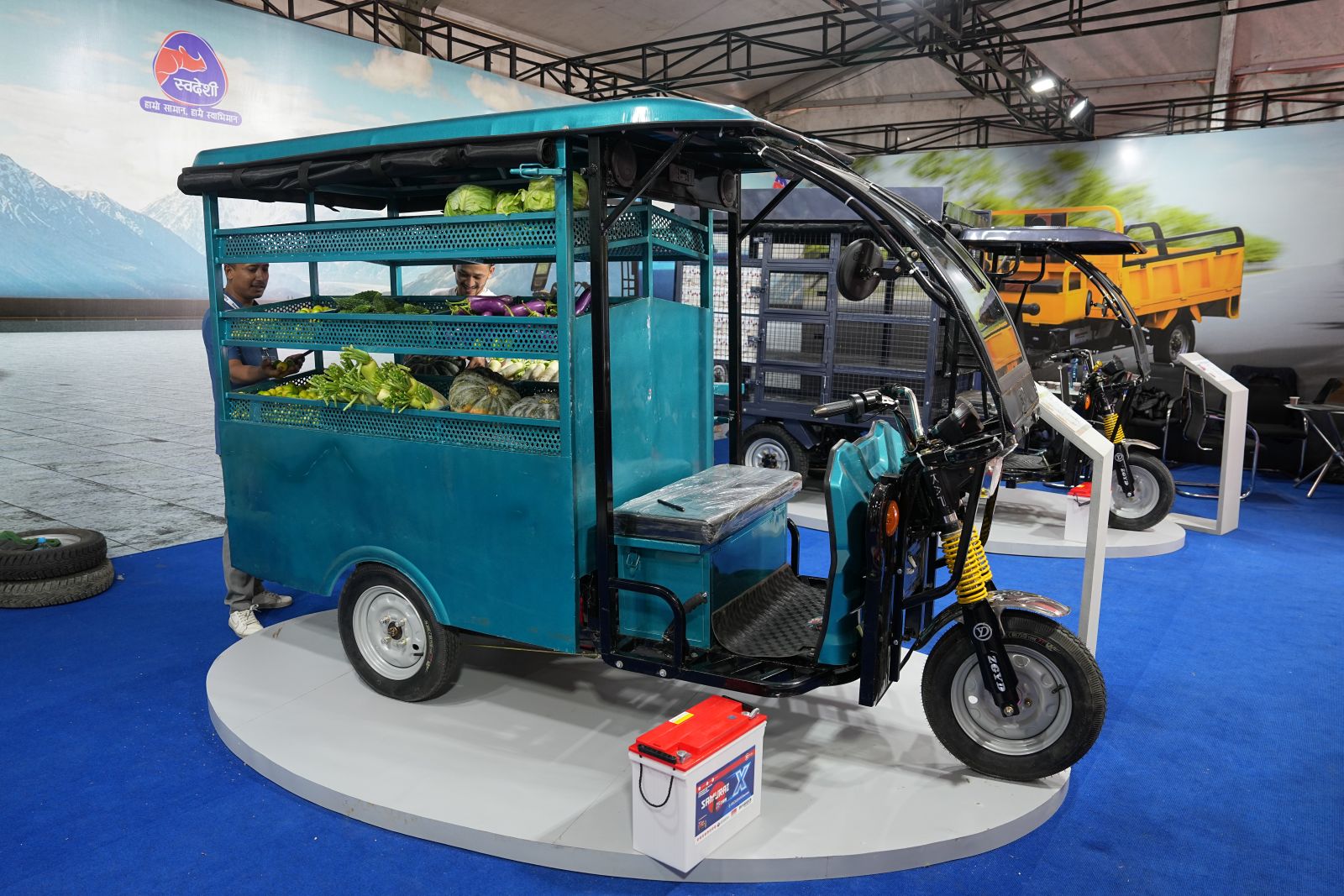
Visitors examine a battery-powered rickshaw during the NAIMA Nepal Mobility Expo 2025 in Kathmandu, Nepal.
Cui Nan / China News Service / VCG via Getty Images
Building out essential infrastructure like power grids is exactly the kind of project that international development institutions like the IMF are supposed to invest in. The IMF and World Bank, both headquartered in Washington, D.C., [were founded](https://www.worldbank.org/en/about/history/the-world-bank-group-and-the-imf) by over 40 allied nations in 1944. Both organizations, along with a series of regional development institutions like the Asian Development Bank, constitute a system whose public goal is to provide loans, research capabilities, and financial advice to developing countries so they can build projects needed to grow their economies. However, throughout their history, both organizations have received criticism for prioritizing debt repayment over well-being within borrower countries, potentially worsening inequality and corporate profiteering.
Today, the largest of these organizations aren’t stepping up to overhaul energy systems in developing countries — in fact, the World Bank abandoned its ambitious climate-related lending goal in June, following the Trump administration’s [calls for it and the IMF to refocus away from climate issues](https://www.reuters.com/sustainability/cop/world-bank-abandon-goal-devote-45-lending-resources-climate-change-projects-2026-06-29/). And the large countries that help fund those organizations, like the United States, European nations, and [China](https://www.cgdev.org/publication/beyond-belt-and-road-responding-evolution-chinas-financing-infrastructure), have recently reduced their funding for infrastructure development in poor countries.
“Developing countries have been caught in a downward spiral of decelerating growth and increased vulnerability,” said Shekhar Aiyar, director of the Indian Council for Research on International Economic Relations, at an event hosted by the [Center for Global Development](https://www.cgdev.org/event/future-mdbs-more-critical-ever) this month. “At the same time, there has been a vast scaling back of bilateral aid” — that is, aid from rich countries to poorer ones.
Wealthy countries have [promised over a trillion dollars](https://grist.org/cop30/cop30-brazil-adaptation-finance/) to help fund climate-related projects in developing nations by 2035, but annual payments are meant to ramp up and aren’t fully available yet. Plus, wealthy countries have historically [failed to meet similar promises](https://www.washingtonpost.com/climate-environment/2023/10/09/rich-nations-pledged-poor-ones-billions-climate-damages-they-arent-paying/).
If there’s a silver lining, it’s that the economic fallout from the Iran war has made the economic importance of transitioning poor countries away from fossil fuels undeniable.
“It’s now more widely understood that decarbonization is a critical goal for macroeconomic stability, and just that recognition is a really encouraging step,” Ray said.
This story was originally published by [Grist](https://grist.org/) with the headline [Soaring oil prices underscore the need to help poor countries adopt renewables](https://grist.org/international/oil-prices-developing-countries-energy-transition-iran-war/) on Oct 22, 2026.
---
**From [Grist](https://grist.org/feed) via [This RSS Feed](https://grist.org/feed).**",
"community": "[email protected]",
"community_title": "Green & indigenous News",
"creator": "[email protected]",
"score": 2,
"comments": 0,
"published": "2026-10-22T09:20:30.272452Z",
"nsfw": false,
"upvotes": 2,
"downvotes": 0,
"newest_comment_time": "2026-10-22T09:20:30.272452Z",
"updated": null,
"thumbnail_url": "https://lemmy.world/pictrs/image/ba16f911-cfca-4d5d-8639-8318f6e557d1.jpeg",
"image_width": 512,
"image_height": 288,
"alt_text": null,
"embed_title": "Soaring oil prices underscore the need to help poor countries adopt renewables",
"embed_description": "Without central planning or public resources, people in developing countries are pursuing an ad hoc energy transition.",
"embed_video_url": null,
"url_content_type": "text/html; charset=utf-8",
"language_id": 0,
"language": null,
"featured": false,
"locked": false,
"creator_display_name": null,
"creator_avatar": "https://news.abolish.capital/pictrs/image/dd8a8e16-ab8b-4e9a-92fd-cde6028b15b4.png",
"creator_url": "https://news.abolish.capital/u/rss",
"creator_bot": true,
"community_url": "https://news.abolish.capital/c/ecosocial",
"community_icon": "https://news.abolish.capital/pictrs/image/8d15e220-cea2-4879-b116-d3ba4e318257.png",
"scraped_at": "2026-11-19T11:07:36.297774+00:00"
},
{
"id": 53031377,
"name": "Building a bike from "scratch" - part 2",
"url": "https://feddit.org/post/36603278",
"ap_id": "https://feddit.org/post/36603278",
"body": "cross-posted from: https://feddit.org/post/36603267
> This is part 2, check out part 1 first!
>
> ## Building
>
> I expected this to be easier (or at least more fun) than the buying process, but sadly it was mostly very annoying. In particular because it turned into another shopping experience, and a worse one for that matter.
>
> ### The parts
>
> Other than the frame, the groupset seems most relevant here. I opted for a non-electric Shimano 105. Thought about going electric and maybe even Chinese OEM as well here, but it didn't seem like the right thing for me. Biking is primarily leisure time fun, and I don't want to mess with another app and think about charging batteries when I'm getting ready to ride. Rather I'll be turning some screws and fiddle with my shifter for a bit. For the wheels I got TPU tubes from RideNow and Continental Grand Prix 5000S (30 wide). Both with no deeper knowledge, but just based on a good review or two I had seen online.
>
> That's it for the obvious parts (from my POV). My groupset order did not come with discs (which I could have deduced from the images), so I got some 160mm ones. It did not come with sleeves for shifter cables either. And my frame could only handle 140 discs in the rear by default, so I had to get an adapter (now while writing this I'm wondering: Do bikes usually come with smaller rear disks? Some do, some run an adapter. I just checked... ). All of these things I realized when trying to assemble, which got frustrating really quick. I had to stop every time and start ordering AGAIN. I don't blame anyone but myself for not checking my orders better, but this made for a very unpleasant building experience. And that was only half of the annoyance...
>
> ### The tools
>
> You will have heard about the EUs push towards unified cables for electronic hardware producers. They should look into bike parts next if you ask me!
>
> I knew ahead of time, that I would need a tool for the Shimano centerlock and the bottom bracket. I managed to order 3 wrong tools for the bottom bracket and the wrong centerlock tool. Naive me just counted the notches on the bottom bracket and ordered the first bottom bracket tool with "Shimano" somewhere in the description. I'll spare you the details, but to get the right one I measured across my bottom bracket and then checked the manufacturers site to find infos about the diameters (shops did not really list these). Just like with the parts, this stopped me in my tracks multiple times and was very unpleasant. Also you might want 1 or 2 torque wrenches, some grease, carbon assembly paste, oil and a bleeding kit for the break lines (which also didn't fit the first time). Some of this I already had, but now I almost feel like a bike shop. Still I'm 100% certain, that the three bottom bracket tools I now own will not be sufficient to service the next bike rolling into my "shop".
>
> 
>
> ### The assembly
>
> With the right tools (and parts) at hand, the actual assembly was mostly straight forward. Getting the cables and break lines into the handlebars was a proper pain though. Other than that: Apply the proper torque, mind the directions, grease up a little and listen to your gut. If something sounds, feels or looks wrong, it probably is. Take a step back and think for a minute. A quick internet search will likely help you in finding everything you would want to know.
>
> Even though the mechanical shifting was a concious and deliberate choice, I'm still convinced: Adjusting your gears properly is sorcery. I spent quite some time on it, the bike strapped up in my power rack, youtube videos left an right. Then I did some more adjusting while out on the road and that's were it finally felt like I achieved something decent. Cheers to the two fellow bikers who stopped while I was fiddling with my bike and asked if everything was all right!
>
> ## Resume
>
> I did not enjoy this project very much. And this has nothing to do with the ordering or the OEM frame. But the special tooling and all the tiny bits and bobs is what really got me. With many other projects, I feel like you can work around lacking tools or material. But in particular the wrenches and nuts are just so specialized (and I didn't want to attack my new gear with a pipe wrench), that I just had to get more and more stuff. Also it didn't help that I'm impatient and apparently bad at reading. When ordering parts and tools, just take some time. This would have saved me at least some of the pain. All the proprietary wrenches and fittings should still be forbidden though.
>
> Now don't get me wrong: I'm glad I did this and I'm very happy with the result. The frame, the wheels, the paint job - everything there worked out like I imagined and I would order one again. I really love the frame! I'm also happy with all the new knowledge and tools, which will help me maintain my bikes in the future. Like bleeding the breaks or changing the bottom bracket was nothing I had done before, and this just pushed me to do it (it's not hard btw). But I guess I had this romantic image in my head where the frame arrived and then I just assemble it in one or two days and then get to go on a ride. Which maybe could have happened, if I had spent more time on checking what I needed. Anyhow: frame good, ordering good, bike tooling and bike parts bad.
>
> 
>
> ## The money
>
> This will be split into two parts:
>
> - Cost of the bike
> - Everything I actually got/had to get
>
> In neither case I went hunting for the best price or product for that matter.
>
> ### Cost of the bike
>
> Money that went into making this a functional, rideable bike.
>
> - Light carbon order: ~1.490 €, split up into:
> - Frame, handlebars, seat post, bottom bracket: 840€
> - Carbon wheels: 320€
> - Bottle cages: 26€
> - Shipping and fees: 300€
> - 105 group set: 430€
> - Discs + spacer + pads: 100€
> - Tubes: 8€
> - Tires: 92€
> - Handlebar tape: 8€
> - Pre waxed Chain: 36€
> - Outer shifting cable: 10€
>
> Makes ~2200€ in total. I had a saddle and pedals at hand, so consider this, but these would not come with a store bought bike either...
>
> ### Cost of building the bike
>
> This will be everything I had to get, to go from "doing some maintenance on a gravel bike" to "assembling a bike".
>
> - Chain pliers: 10€
> - Chain wrench: 32€
> - Bleed kit & oil: 32€
> - Centerlock tool: 20€
> - 3* bottom bracket tool: ~100€
> - Carbon paste: 10€
>
> So at least 200€ more, while all of these could have been borrowed. The torque wrench I had gotten (a little ahead of time) would almost double that, since I'm seemingly unable to go cheap. The second torque wrench is a friends. This really is individual and mostly relevant to myself.
>
> ### Was it worth it?
>
> This is hard to judge, since this bike does not exist on the market. So I started thinking about it this way:
>
> - Would I have gotten a road bike, if not building it? Yes. Maybe not this year, but within the next 1-3 years for sure.
> - Would I have least a bike? No. I believe in owning stuff, and my job doesn't offer it anyway.
> - How much would I have spent on a bike? I'm in love with the Canyon Aeroad ever since I saw it, which ain't cheap.
>
> I don't think I would have dropped 4-8k on an Aeroad, even used they are a little too pricey for me atm. Also, even when not considering differences in frame and wheels (that I can't judge), I have cheaper components than any version of the Aeroad. That said, I have a hard time finding a carbon frame (and wheels) for around 2k new. So I like to imagine that I did indeed save some money (not billing my time ofc). A highly subjective verdict obviously.
>
> If you are looking for guidance and the above is not enough: I would not recommend doing this for your first bike. Rather get a "complete" bike, go out riding, enjoy summer, learn something about bikes first. If you already have a bike, some tools, friends with tools, an open bike shop close by, this might be something for you. You can learn a lot, and I feel a lot more confident in maintaining bikes now.",
"community": "[email protected]",
"community_title": "Fahrrad",
"creator": "[email protected]",
"score": 6,
"comments": 1,
"published": "2026-10-12T12:08:31.744308Z",
"nsfw": false,
"upvotes": 6,
"downvotes": 0,
"newest_comment_time": "2026-10-12T13:26:48.484Z",
"updated": null,
"thumbnail_url": null,
"image_width": null,
"image_height": null,
"alt_text": null,
"embed_title": null,
"embed_description": null,
"embed_video_url": null,
"url_content_type": null,
"language_id": 37,
"language": "en",
"featured": false,
"locked": false,
"creator_display_name": "TheHive",
"creator_avatar": null,
"creator_url": "https://feddit.org/u/luftruessel",
"creator_bot": false,
"community_url": "https://feddit.org/c/fahrrad",
"community_icon": "https://feddit.org/pictrs/image/a916733b-d826-46dc-b770-0ed6a829f12b.jpeg",
"scraped_at": "2026-11-19T11:07:36.297774+00:00"
},
{
"id": 53031326,
"name": "Building a bike from "scratch" - part 2",
"url": "https://feddit.org/post/36603277",
"ap_id": "https://feddit.org/post/36603277",
"body": "cross-posted from: https://feddit.org/post/36603267
> This is part 2, check out part 1 first!
>
> ## Building
>
> I expected this to be easier (or at least more fun) than the buying process, but sadly it was mostly very annoying. In particular because it turned into another shopping experience, and a worse one for that matter.
>
> ### The parts
>
> Other than the frame, the groupset seems most relevant here. I opted for a non-electric Shimano 105. Thought about going electric and maybe even Chinese OEM as well here, but it didn't seem like the right thing for me. Biking is primarily leisure time fun, and I don't want to mess with another app and think about charging batteries when I'm getting ready to ride. Rather I'll be turning some screws and fiddle with my shifter for a bit. For the wheels I got TPU tubes from RideNow and Continental Grand Prix 5000S (30 wide). Both with no deeper knowledge, but just based on a good review or two I had seen online.
>
> That's it for the obvious parts (from my POV). My groupset order did not come with discs (which I could have deduced from the images), so I got some 160mm ones. It did not come with sleeves for shifter cables either. And my frame could only handle 140 discs in the rear by default, so I had to get an adapter (now while writing this I'm wondering: Do bikes usually come with smaller rear disks? Some do, some run an adapter. I just checked... ). All of these things I realized when trying to assemble, which got frustrating really quick. I had to stop every time and start ordering AGAIN. I don't blame anyone but myself for not checking my orders better, but this made for a very unpleasant building experience. And that was only half of the annoyance...
>
> ### The tools
>
> You will have heard about the EUs push towards unified cables for electronic hardware producers. They should look into bike parts next if you ask me!
>
> I knew ahead of time, that I would need a tool for the Shimano centerlock and the bottom bracket. I managed to order 3 wrong tools for the bottom bracket and the wrong centerlock tool. Naive me just counted the notches on the bottom bracket and ordered the first bottom bracket tool with "Shimano" somewhere in the description. I'll spare you the details, but to get the right one I measured across my bottom bracket and then checked the manufacturers site to find infos about the diameters (shops did not really list these). Just like with the parts, this stopped me in my tracks multiple times and was very unpleasant. Also you might want 1 or 2 torque wrenches, some grease, carbon assembly paste, oil and a bleeding kit for the break lines (which also didn't fit the first time). Some of this I already had, but now I almost feel like a bike shop. Still I'm 100% certain, that the three bottom bracket tools I now own will not be sufficient to service the next bike rolling into my "shop".
>
> 
>
> ### The assembly
>
> With the right tools (and parts) at hand, the actual assembly was mostly straight forward. Getting the cables and break lines into the handlebars was a proper pain though. Other than that: Apply the proper torque, mind the directions, grease up a little and listen to your gut. If something sounds, feels or looks wrong, it probably is. Take a step back and think for a minute. A quick internet search will likely help you in finding everything you would want to know.
>
> Even though the mechanical shifting was a concious and deliberate choice, I'm still convinced: Adjusting your gears properly is sorcery. I spent quite some time on it, the bike strapped up in my power rack, youtube videos left an right. Then I did some more adjusting while out on the road and that's were it finally felt like I achieved something decent. Cheers to the two fellow bikers who stopped while I was fiddling with my bike and asked if everything was all right!
>
> ## Resume
>
> I did not enjoy this project very much. And this has nothing to do with the ordering or the OEM frame. But the special tooling and all the tiny bits and bobs is what really got me. With many other projects, I feel like you can work around lacking tools or material. But in particular the wrenches and nuts are just so specialized (and I didn't want to attack my new gear with a pipe wrench), that I just had to get more and more stuff. Also it didn't help that I'm impatient and apparently bad at reading. When ordering parts and tools, just take some time. This would have saved me at least some of the pain. All the proprietary wrenches and fittings should still be forbidden though.
>
> Now don't get me wrong: I'm glad I did this and I'm very happy with the result. The frame, the wheels, the paint job - everything there worked out like I imagined and I would order one again. I really love the frame! I'm also happy with all the new knowledge and tools, which will help me maintain my bikes in the future. Like bleeding the breaks or changing the bottom bracket was nothing I had done before, and this just pushed me to do it (it's not hard btw). But I guess I had this romantic image in my head where the frame arrived and then I just assemble it in one or two days and then get to go on a ride. Which maybe could have happened, if I had spent more time on checking what I needed. Anyhow: frame good, ordering good, bike tooling and bike parts bad.
>
> 
>
> ## The money
>
> This will be split into two parts:
>
> - Cost of the bike
> - Everything I actually got/had to get
>
> In neither case I went hunting for the best price or product for that matter.
>
> ### Cost of the bike
>
> Money that went into making this a functional, rideable bike.
>
> - Light carbon order: ~1.490 €, split up into:
> - Frame, handlebars, seat post, bottom bracket: 840€
> - Carbon wheels: 320€
> - Bottle cages: 26€
> - Shipping and fees: 300€
> - 105 group set: 430€
> - Discs + spacer + pads: 100€
> - Tubes: 8€
> - Tires: 92€
> - Handlebar tape: 8€
> - Pre waxed Chain: 36€
> - Outer shifting cable: 10€
>
> Makes ~2200€ in total. I had a saddle and pedals at hand, so consider this, but these would not come with a store bought bike either...
>
> ### Cost of building the bike
>
> This will be everything I had to get, to go from "doing some maintenance on a gravel bike" to "assembling a bike".
>
> - Chain pliers: 10€
> - Chain wrench: 32€
> - Bleed kit & oil: 32€
> - Centerlock tool: 20€
> - 3* bottom bracket tool: ~100€
> - Carbon paste: 10€
>
> So at least 200€ more, while all of these could have been borrowed. The torque wrench I had gotten (a little ahead of time) would almost double that, since I'm seemingly unable to go cheap. The second torque wrench is a friends. This really is individual and mostly relevant to myself.
>
> ### Was it worth it?
>
> This is hard to judge, since this bike does not exist on the market. So I started thinking about it this way:
>
> - Would I have gotten a road bike, if not building it? Yes. Maybe not this year, but within the next 1-3 years for sure.
> - Would I have least a bike? No. I believe in owning stuff, and my job doesn't offer it anyway.
> - How much would I have spent on a bike? I'm in love with the Canyon Aeroad ever since I saw it, which ain't cheap.
>
> I don't think I would have dropped 4-8k on an Aeroad, even used they are a little too pricey for me atm. Also, even when not considering differences in frame and wheels (that I can't judge), I have cheaper components than any version of the Aeroad. That said, I have a hard time finding a carbon frame (and wheels) for around 2k new. So I like to imagine that I did indeed save some money (not billing my time ofc). A highly subjective verdict obviously.
>
> If you are looking for guidance and the above is not enough: I would not recommend doing this for your first bike. Rather get a "complete" bike, go out riding, enjoy summer, learn something about bikes first. If you already have a bike, some tools, friends with tools, an open bike shop close by, this might be something for you. You can learn a lot, and I feel a lot more confident in maintaining bikes now.",
"community": "[email protected]",
"community_title": "micromobility - Bikes, scooters, boards: Whatever floats your goat, this is micromobility",
"creator": "[email protected]",
"score": 14,
"comments": 1,
"published": "2026-10-12T12:07:58.464581Z",
"nsfw": false,
"upvotes": 14,
"downvotes": 0,
"newest_comment_time": "2026-10-12T13:22:46.993038Z",
"updated": null,
"thumbnail_url": null,
"image_width": null,
"image_height": null,
"alt_text": null,
"embed_title": null,
"embed_description": null,
"embed_video_url": null,
"url_content_type": null,
"language_id": 37,
"language": "en",
"featured": false,
"locked": false,
"creator_display_name": "TheHive",
"creator_avatar": null,
"creator_url": "https://feddit.org/u/luftruessel",
"creator_bot": false,
"community_url": "https://lemmy.world/c/micromobility",
"community_icon": null,
"scraped_at": "2026-11-19T11:07:36.297774+00:00"
},
{
"id": 53055116,
"name": "Building a bike from "scratch" - part 2",
"url": "https://feddit.org/pictrs/image/2f3bf33b-a393-40b5-a24c-be7e411287f2.png",
"ap_id": "https://feddit.org/post/36603267",
"body": "This is part 2, check out [part 1](https://feddit.org/post/36017235) first!
## Building
I expected this to be easier (or at least more fun) than the buying process, but sadly it was mostly very annoying. In particular because it turned into another shopping experience, and a worse one for that matter.
### The parts
Other than the frame, the groupset seems most relevant here. I opted for a non-electric Shimano 105. Thought about going electric and maybe even Chinese OEM as well here, but it didn't seem like the right thing for me. Biking is primarily leisure time fun, and I don't want to mess with another app and think about charging batteries when I'm getting ready to ride. Rather I'll be turning some screws and fiddle with my shifter for a bit. For the wheels I got TPU tubes from RideNow and Continental Grand Prix 5000S (30 wide). Both with no deeper knowledge, but just based on a good review or two I had seen online.
That's it for the obvious parts (from my POV). My groupset order did not come with discs (which I could have deduced from the images), so I got some 160mm ones. It did not come with sleeves for shifter cables either. And my frame could only handle 140 discs in the rear by default, so I had to get an adapter (now while writing this I'm wondering: Do bikes usually come with smaller rear disks? Some do, some run an adapter. I just checked... ). All of these things I realized when trying to assemble, which got frustrating really quick. I had to stop every time and start ordering AGAIN. I don't blame anyone but myself for not checking my orders better, but this made for a very unpleasant building experience. And that was only half of the annoyance...
### The tools
You will have heard about the EUs push towards unified cables for electronic hardware producers. They should look into bike parts next if you ask me!
I knew ahead of time, that I would need a tool for the Shimano centerlock and the bottom bracket. I managed to order 3 wrong tools for the bottom bracket and the wrong centerlock tool. Naive me just counted the notches on the bottom bracket and ordered the first bottom bracket tool with "Shimano" somewhere in the description. I'll spare you the details, but to get the right one I measured across my bottom bracket and then checked the manufacturers site to find infos about the diameters (shops did not really list these). Just like with the parts, this stopped me in my tracks multiple times and was very unpleasant. Also you might want 1 or 2 torque wrenches, some grease, carbon assembly paste, oil and a bleeding kit for the break lines (which also didn't fit the first time). Some of this I already had, but now I almost feel like a bike shop. Still I'm 100% certain, that the three bottom bracket tools I now own will not be sufficient to service the next bike rolling into my "shop".

### The assembly
With the right tools (and parts) at hand, the actual assembly was mostly straight forward. Getting the cables and break lines into the handlebars was a proper pain though. Other than that: Apply the proper torque, mind the directions, grease up a little and listen to your gut. If something sounds, feels or looks wrong, it probably is. Take a step back and think for a minute. A quick internet search will likely help you in finding everything you would want to know.
Even though the mechanical shifting was a concious and deliberate choice, I'm still convinced: Adjusting your gears properly is sorcery. I spent quite some time on it, the bike strapped up in my power rack, youtube videos left an right. Then I did some more adjusting while out on the road and that's were it finally felt like I achieved something decent. Cheers to the two fellow bikers who stopped while I was fiddling with my bike and asked if everything was all right!
## Resume
I did not enjoy this project very much. And this has nothing to do with the ordering or the OEM frame. But the special tooling and all the tiny bits and bobs is what really got me. With many other projects, I feel like you can work around lacking tools or material. But in particular the wrenches and nuts are just so specialized (and I didn't want to attack my new gear with a pipe wrench), that I just had to get more and more stuff. Also it didn't help that I'm impatient and apparently bad at reading. When ordering parts and tools, just take some time. This would have saved me at least some of the pain. All the proprietary wrenches and fittings should still be forbidden though.
Now don't get me wrong: I'm glad I did this and I'm very happy with the result. The frame, the wheels, the paint job - everything there worked out like I imagined and I would order one again. I really love the frame! I'm also happy with all the new knowledge and tools, which will help me maintain my bikes in the future. Like bleeding the breaks or changing the bottom bracket was nothing I had done before, and this just pushed me to do it (it's not hard btw). But I guess I had this romantic image in my head where the frame arrived and then I just assemble it in one or two days and then get to go on a ride. Which maybe could have happened, if I had spent more time on checking what I needed. Anyhow: frame good, ordering good, bike tooling and bike parts bad.

## The money
This will be split into two parts:
- Cost of the bike
- Everything I actually got/had to get
In neither case I went hunting for the best price or product for that matter.
### Cost of the bike
Money that went into making this a functional, rideable bike.
- Light carbon order: ~1.490 €, split up into:
- Frame, handlebars, seat post, bottom bracket: 840€
- Carbon wheels: 320€
- Bottle cages: 26€
- Shipping and fees: 300€
- 105 group set: 430€
- Discs + spacer + pads: 100€
- Tubes: 8€
- Tires: 92€
- Handlebar tape: 8€
- Pre waxed Chain: 36€
- Outer shifting cable: 10€
Makes ~2200€ in total. I had a saddle and pedals at hand, so consider this, but these would not come with a store bought bike either...
### Cost of building the bike
This will be everything I had to get, to go from "doing some maintenance on a gravel bike" to "assembling a bike".
- Chain pliers: 10€
- Chain wrench: 32€
- Bleed kit & oil: 32€
- Centerlock tool: 20€
- 3* bottom bracket tool: ~100€
- Carbon paste: 10€
So at least 200€ more, while all of these could have been borrowed. The torque wrench I had gotten (a little ahead of time) would almost double that, since I'm seemingly unable to go cheap. The second torque wrench is a friends. This really is individual and mostly relevant to myself.
### Was it worth it?
This is hard to judge, since this bike does not exist on the market. So I started thinking about it this way:
- Would I have gotten a road bike, if not building it? Yes. Maybe not this year, but within the next 1-3 years for sure.
- Would I have least a bike? No. I believe in owning stuff, and my job doesn't offer it anyway.
- How much would I have spent on a bike? I'm in love with the Canyon Aeroad ever since I saw it, which ain't cheap.
I don't think I would have dropped 4-8k on an Aeroad, even used they are a little too pricey for me atm. Also, even when not considering differences in frame and wheels (that I can't judge), I have cheaper components than any version of the Aeroad. That said, I have a hard time finding a carbon frame (and wheels) for around 2k new. So I like to imagine that I did indeed save some money (not billing my time ofc). A highly subjective verdict obviously.
If you are looking for guidance and the above is not enough: I would not recommend doing this for your first bike. Rather get a "complete" bike, go out riding, enjoy summer, learn something about bikes first. If you already have a bike, some tools, friends with tools, an open bike shop close by, this might be something for you. You can learn a lot, and I feel a lot more confident in maintaining bikes now.",
"community": "[email protected]",
"community_title": "Do It Yourself",
"creator": "[email protected]",
"score": 3,
"comments": 2,
"published": "2026-10-12T12:06:59.991458Z",
"nsfw": false,
"upvotes": 3,
"downvotes": 0,
"newest_comment_time": "2026-11-15T08:19:17.298125Z",
"updated": "2026-10-12T14:30:56.756066Z",
"thumbnail_url": "https://lemmy.world/pictrs/image/fa689938-2074-483a-b8cf-4d1cf78737fb.png",
"image_width": 512,
"image_height": 374,
"alt_text": null,
"embed_title": null,
"embed_description": null,
"embed_video_url": null,
"url_content_type": "image/png",
"language_id": 37,
"language": "en",
"featured": false,
"locked": false,
"creator_display_name": "TheHive",
"creator_avatar": null,
"creator_url": "https://feddit.org/u/luftruessel",
"creator_bot": false,
"community_url": "https://beehaw.org/c/diy",
"community_icon": "https://beehaw.org/pictrs/image/847a7f32-d140-4db8-9fd1-ea26da513063.png",
"scraped_at": "2026-11-19T11:07:36.297774+00:00"
},
{
"id": 52774139,
"name": "Reducing National Dependency On Oil",
"url": "https://ezranaamah.substack.com/p/reducing-national-dependency-on-oil",
"ap_id": "https://lemmy.world/post/52774139",
"body": "Science has given us countless alternatives to a dependence on oil and its derivatives. Walkable cities, electric cars, even old fashioned bikes as demonstrated in some European cities. Despite this, the US regime has continued with its stubborn dependence on oil and imported resources as the basis for its economy and even basic transport for its citizens. If the situation was not fragile enough, the American and Israeli regimes engaged in a senseless provocation of Iran which has led to a blockade of their most desperately needed resource. The economy and basic infrastructure in the US such as transportation and energy currently face a threat of collapse under the strain put on them by the shortage of oil caused by the actions of our leadership, with the people left to pick up the pieces. With diesel trucks now costing hundreds to refuel, even basic supply lines for goods like food are at a high risk of collapse. Even the cost of basic raw materials and food will inflate under the economic demands of trucking with inflated diesel costs.
The urbanates provide a simple and effective solution to the problem of oil dependency. Urbanates would be designed in a way that allows for walkability and this would have a positive effect on conservation and sustainability. Current city plans are designed around land and property ownership which means urbanization is extremely slow and inefficient with resistance from the population in an area. Combined with a resistance to public transport from the middle and upper classes holding all the political power in plutocracies, every non-urban household experiences financial distress or a complete loss of transportation in the event of an oil shortage. While city centers are safe from the transportation-related effects from an oil shortage, grocery prices and raw materials are still vulnerable to inflation since so much infrastructure and food production relies on oil. Energy Accounting would shift production to be reliant on domestic energy, and scientific advancements in electric vehicles and energy production combined means oil could become obsolete in our lifetime if the ruling class backing it is overthrown.
A lack of dependence on oil for the West or even just the Technate would be the beginning of the end for western imperialism on the rest of the world. Without constant economic pressure to invade, pillage and subjugate other countries, the military-industrial complex will lose a major justification for its existence. The white house will have less incentive to “spread democracy” in a world where nuclear and solar electricity are the basis of its economy and the operative power for its vehicles and machinery. The Technate of North America and its citizenry could finally be the main beneficiaries of its economic growth rather than warlords and billionaires that profit off of war and genocide.
While the American regime has deliberately raised the cost of electric vehicles and imposes egregious tariffs on superior products from abroad, economic demand and practical necessity is likely to put pressure on the regime to open its markets and allow its citizens to decide what products to consume in their daily lives. This regime will fall to revolution as soon as it can no longer control its population through ignorance, ideological indoctrination and physical force. Without oil for its most basic infrastructure and enemies everywhere, the White House has a limited number of days remaining. Technocrats and experts must be ready to advance our country towards the next stage of human development, where we can achieve scientific government.",
"community": "[email protected]",
"community_title": "Technocracy",
"creator": "[email protected]",
"score": 1,
"comments": 0,
"published": "2026-10-05T23:10:48.012369Z",
"nsfw": false,
"upvotes": 2,
"downvotes": 1,
"newest_comment_time": "2026-10-05T23:10:48.012369Z",
"updated": null,
"thumbnail_url": "https://lemmy.world/pictrs/image/8ae4a84e-3e00-4572-81e1-9e882cec8a9f.jpeg",
"image_width": 512,
"image_height": 267,
"alt_text": null,
"embed_title": "Reducing National Dependency On Oil",
"embed_description": "Science has given us countless alternatives to a dependence on oil and its derivatives.",
"embed_video_url": null,
"url_content_type": "text/html; charset=utf-8",
"language_id": 0,
"language": null,
"featured": false,
"locked": false,
"creator_display_name": "Ezra Naamah",
"creator_avatar": "https://lemmy.world/pictrs/image/2174fe80-7ecc-40ec-b750-779811154584.jpeg",
"creator_url": "https://lemmy.world/u/EzraNaamah",
"creator_bot": false,
"community_url": "https://lemmy.world/c/technocracy",
"community_icon": "https://lemmy.world/pictrs/image/547a0141-8b66-44dd-80b3-4a2c64976222.png",
"scraped_at": "2026-11-19T11:07:36.297774+00:00"
}
]
}
GET
/v1/lemmy/search_posts1 kredyt / uruchomienie ZweryfikowanySearch Posts
Keyword search over Lemmy posts via the public lemmy.world API v3 (type_=Posts, federated results included; lemmy.ml answers when lemmy.world is down or rate-limits, see `instance`). url is the linked URL, or the post's ActivityPub id for text posts.
Parametry
| Nazwa | Typ | Wym. | Opis |
|---|---|---|---|
| query | string | tak | Search query. |
| Filtry zaawansowane | |||
| limit | integer | nie | Results per page (1-50). (domyślnie: 20) |
| sort | string | nie | Lemmy sort, e.g. New, TopAll, TopWeek, MostComments (default: the instance's own order). |
| community | string | nie | Only this community, as name or name@instance (e.g. [email protected]). |
| cursor | string | nie | Pagination cursor (from nextCursor; a page number). |